
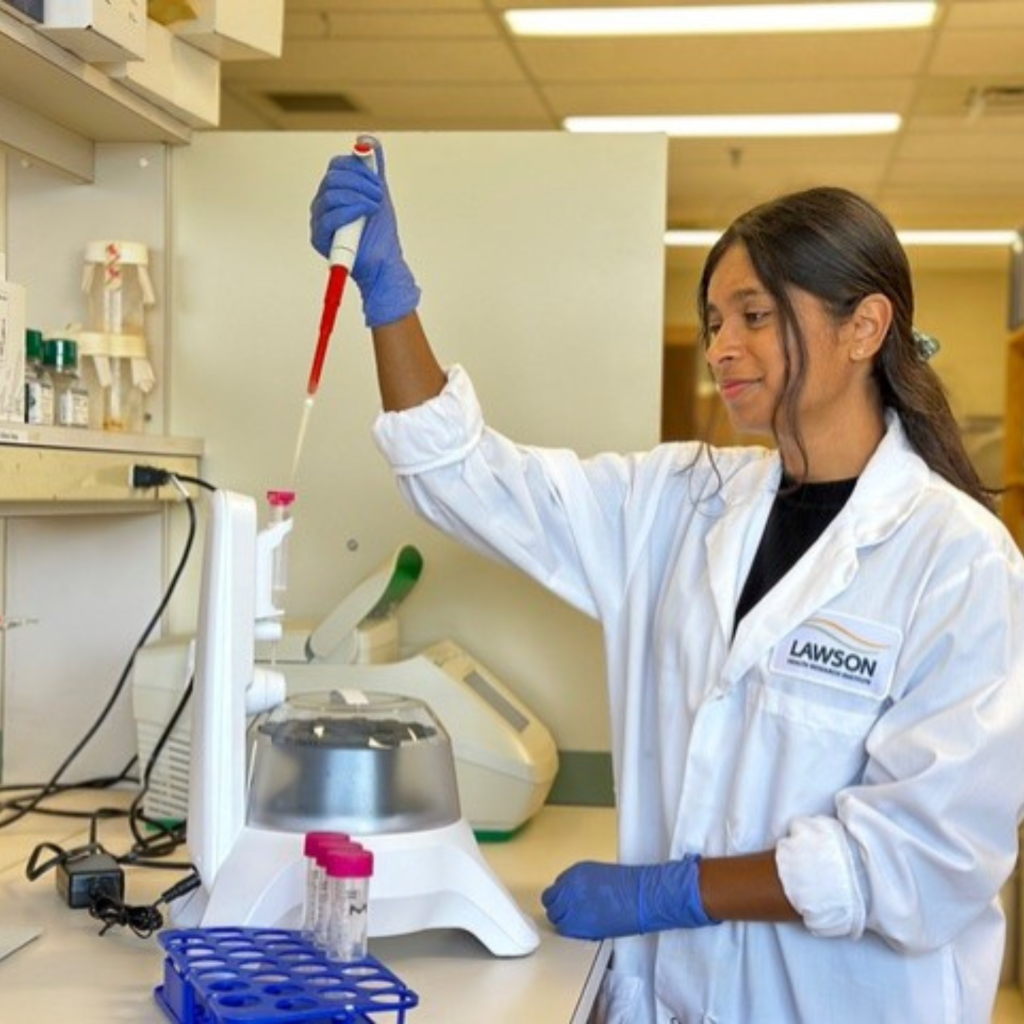
Urvi Patel is a PhD student in the Department of Anatomy & Cell Biology at Western University. She is conducting BCC-funded breast cancer research under the mentorship of Dr. Alison Allan at the London Health Sciences Centre/Western University.
- What specific areas of breast cancer research are you currently focusing on, and why are they important?
My research focuses on how breast cancer spreads to the lungs, especially in triple negative breast cancer, which is one of the more aggressive types of the disease. I study tiny particles called extracellular vesicles, or EVs. These are tiny packages released by cancer cells that carry messages to other parts of the body. These messages can travel to the lungs and change the environment there, making it easier for cancer to grow. I am working to understand what messages these EVs carry and how they prepare the lungs for cancer spread. I am also testing whether a drug called tipifarnib can block the release of these particles, which could help slow or prevent metastasis. This research is important because it could lead to new ways to stop breast cancer from spreading, which is the main cause of serious illness in patients.
- What recent breakthroughs or discoveries in Canadian breast cancer research are exciting to you?
Breast cancer research is continuously advancing, and it is exciting to see how new technologies are improving patient care. For example, doctors are starting to combine imaging tools like ultrasound with artificial intelligence (AI) to predict how a tumour will respond to treatment. This can help adjust treatments earlier and improve outcomes for patients. There have also been advances in immunotherapy, which helps the body’s immune system better recognize and fight cancer. Overall, these new approaches are helping make treatments more personalized and more effective.
- How do you see the future of breast cancer prevention, screening, diagnosis, treatment evolving through research?
The future of breast cancer care is becoming more personalized, thanks to rapid advances in research. New tools like blood tests, sometimes called “liquid biopsies,” and genetic testing are helping doctors better understand each patient’s cancer. This makes it easier to choose treatments that are most likely to work for that individual. At the same time, large research studies are helping identify new biomarkers for earlier detection and new targets for treatment. As we continue to learn more about how complex breast cancer is, this knowledge will help guide better ways to prevent, detect, and treat the disease for each patient.
- What advice do you have for young individuals interested in pursuing a career in breast cancer research?
For young individuals interested in a career in breast cancer research, I encourage them to pursue questions that genuinely spark their curiosity, as passion helps sustain motivation through the challenges of research. Take time to explore unfamiliar topics and build a strong foundation by asking questions. Connecting with researchers, both students and professors, to learn about ongoing studies can also provide insight into the many areas breast cancer research touches, from basic biology to new technologies in screening and diagnosis. Finally, seeking out volunteer positions, internships, or lab opportunities to gain hands-on experience and discover where your interests truly lie. These experiences will provide valuable connections that can benefit in the future as well.
- In your opinion, what role can public awareness and advocacy play in advancing breast cancer research and treatment?
Public awareness and advocacy play a vital role in advancing breast cancer research and treatment. It allows the public to stay informed about the current progress in the field as new discoveries are continuously being made. Public awareness leads to development of supportive networks that allow researchers and patients to connect. Advocacy amplifies the patient perspective to ensure research prioritizes patient-centred initiatives. Increasing public awareness can encourage communities to participate in screening programs and fundraising efforts that drive research forward.