
Beyond the Treatment Calendar: Reflecting on Breast Cancer
The American Society of Clinical Oncology (ASCO) Annual Meeting is famously known as the place where ground-breaking clinical trials make their global debut. But beneath the headlines of percentages, survival curves, and molecule names, a vital shift is taking place. At ASCO 2026, held under the global theme “The Science and Practice of Translation: Improving Cancer Outcomes Worldwide,” the oncology community loudly acknowledged a fundamental truth: beating cancer isn’t just about surviving after a disease-free scan; it’s about how we live through every stage of the journey.
For Breast Cancer Canada, this year’s discussions centered heavily around a modernized definition of survivorship: one that expands past the traditional “post-treatment” lens to encompass both life after active therapy and life during long-term, ongoing treatment for metastatic disease. It is about bridging the gap between the lab, the clinic, and the everyday reality of patients reclaiming their quality of life.
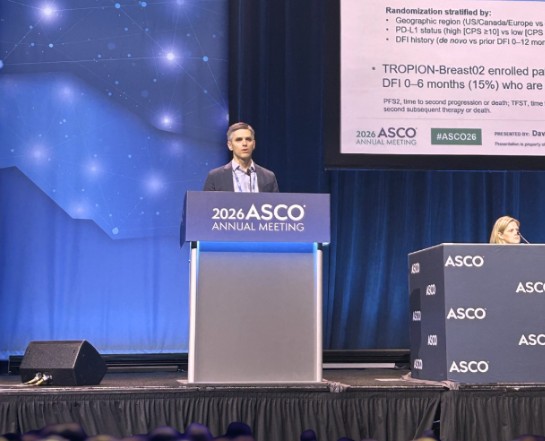
Leading voices, including Canada’s own Dr. David Cescon from the Princess Margaret Cancer Centre in Toronto, were right at the intersection of this exciting evolution. Dr. Cescon, whose work is actively supported by two Breast Cancer Canada research grants and who serves as an expert with BCC’s REAL Canadian Breast Cancer Alliance, exemplified how Canadian leadership is driving this dual approach to care.
Redefining Realities Across the Continuum: The TROPION-Breast02 Trial
When we look at survivorship through a comprehensive lens, it begins with finding more effective, less toxic tools to manage the disease at any stage. Dr. Cescon stepped up to the podium in Chicago to present highly anticipated data from the TROPION-Breast02 Trial (Abstract 1002).
The trial evaluated an advanced antibody-drug conjugate (ADC) called datopotamab deruxtecan (Dato-DXd) as a potential first-line treatment option against standard chemotherapy. Notably, this trial focused on patients with locally recurrent inoperable or metastatic triple-negative breast cancer (TNBC) who aren’t candidates for immunotherapy.
- Why it matters for survivorship during treatment: Triple-negative breast cancer has historically been incredibly tough to treat. Dr. Cescon presented new data checking if the early survival benefits of Dato-DXd held strong through downstream endpoints, like subsequent lines of therapy. In a metastatic setting, survivorship means longevity paired with quality of life.
- By establishing a higher, more targeted standard of care right from the start, researchers are aiming to buy patients living with metastatic disease more time, while sparing them from the brutal, widespread side effects typical of traditional chemotherapy.
Guiding the Big Conversations: The Breast Cancer Education Track
Beyond presenting metastatic clinical data, Dr. Cescon played a monumental role as the Chair of the ASCO Breast Cancer Education Track. This specific track serves as the bridge between clinical data and real-world practice, guiding multidisciplinary conversations on how to treat the whole patient—whether they are navigating early-stage recovery or managing a chronic, advanced diagnosis.
Under his leadership, the sessions focused heavily on tailored surveillance and personalized care:
- Catching Recurrence and Monitoring Progression: Deep-dive discussions into liquid biopsies and molecular residual disease (MRD) monitoring. This cutting-edge science aims to detect microscopic traces of cancer DNA in the blood long before a physical tumor shows up on a traditional scan. For patients in early stages, MRD monitoring offers the ultimate dream of peace of mind or early intervention. For those in long-term treatment, advanced surveillance tools mean clearer windows into how a treatment is holding, allowing for more personalized and agile adjustments to care.
- Subtype Updates: Tailoring survivorship and maintenance plans to the distinct biological realities of different breast cancer subtypes, because a triple-negative diagnosis requires a vastly different long-term wellness and surveillance strategy than an ER-positive diagnosis, demanding a personal touch for every patient.
Treating the Whole Person
While the clinical tracks focused on managing the physical disease, separate, powerful panels at ASCO 2026 targeted what patient advocates call the high, persistent, and multidimensional burden of cancer survivorship.
Advocates highlighted that whether a patient has finished active treatment or is undergoing long-term maintenance therapy, the psychological and physical toll remains an ongoing reality. From managing fatigue, anxiety, and cardiometabolic health to addressing the near-universal fear of recurrence or progression, survivorship is a continuous part of the cancer spectrum.
The conference brought forward crucial data on managing the side effects that steal quality of life from patients during and after treatment:
- The Weight Management Battle: Over two-thirds of premenopausal breast cancer patients experience significant weight gain after treatment due to endocrine (hormone) therapy. ASCO 2026 introduced promising real-world data exploring how modern weight management interventions, like GLP-1 receptor agonists, might play a dual role in improving a patient’s metabolic health and reducing long-term recurrence risks.
- Managing Menopause and Sleep: Incredible data emerged around new non-hormonal oral therapies (like elinzanetant) that safely and significantly improve hot flashes, sleep disturbances, and overall physical and psychosocial symptoms of menopause for women on hormone-blocking therapies.
Turning Science into Living
The takeaway from ASCO 2026 is clear: survivorship isn’t an afterthought that begins only when treatment ends; it is an ongoing, essential component of care that requires better tools, smarter monitoring, and more personalized surveillance.
Thanks to the rigorous clinical research of experts like Dr. Cescon and the relentless push from patient advocates, the medical community is moving toward a future where progress is measured not just by how a tumor responds, but by how a patient lives.
At Breast Cancer Canada, we will continue to champion the funding of life-saving research that ensures every breast cancer patient: whether navigating early recovery or living long-term with metastatic disease—is supported to live a vibrant, full life.
References:
ASCO Annual Meeting 2026 – Survivorship and Surveillance Themes
American Society of Clinical Oncology (ASCO). ASCO Annual Meeting 2026: Abstracts, education sessions, and scientific programming on survivorship, surveillance, liquid biopsy, and molecular residual disease (MRD).
www.asco.org/annual-meeting/program/abstracts-posters
Breast Cancer Education Track – Leadership and Surveillance Innovation
Cescon DW, et al. ASCO Breast Cancer Education Track: Multidisciplinary advances in breast cancer surveillance, including liquid biopsy and molecular residual disease (MRD) monitoring.
ASCO Annual Meeting 2026 Educational Programming
www.asco.org/annual-meeting/program
Liquid Biopsy and MRD in Breast Cancer
Molecular residual disease (MRD) and circulating tumour DNA (ctDNA) as emerging tools for post-treatment surveillance and early detection of recurrence in breast cancer.
Journal of Clinical Oncology / ASCO Publications
ascopubs.org
Breast Cancer Canada’s 2026 Survivorship Announcement:
breastcancer.ca/bccs-survivorship-strategy/