
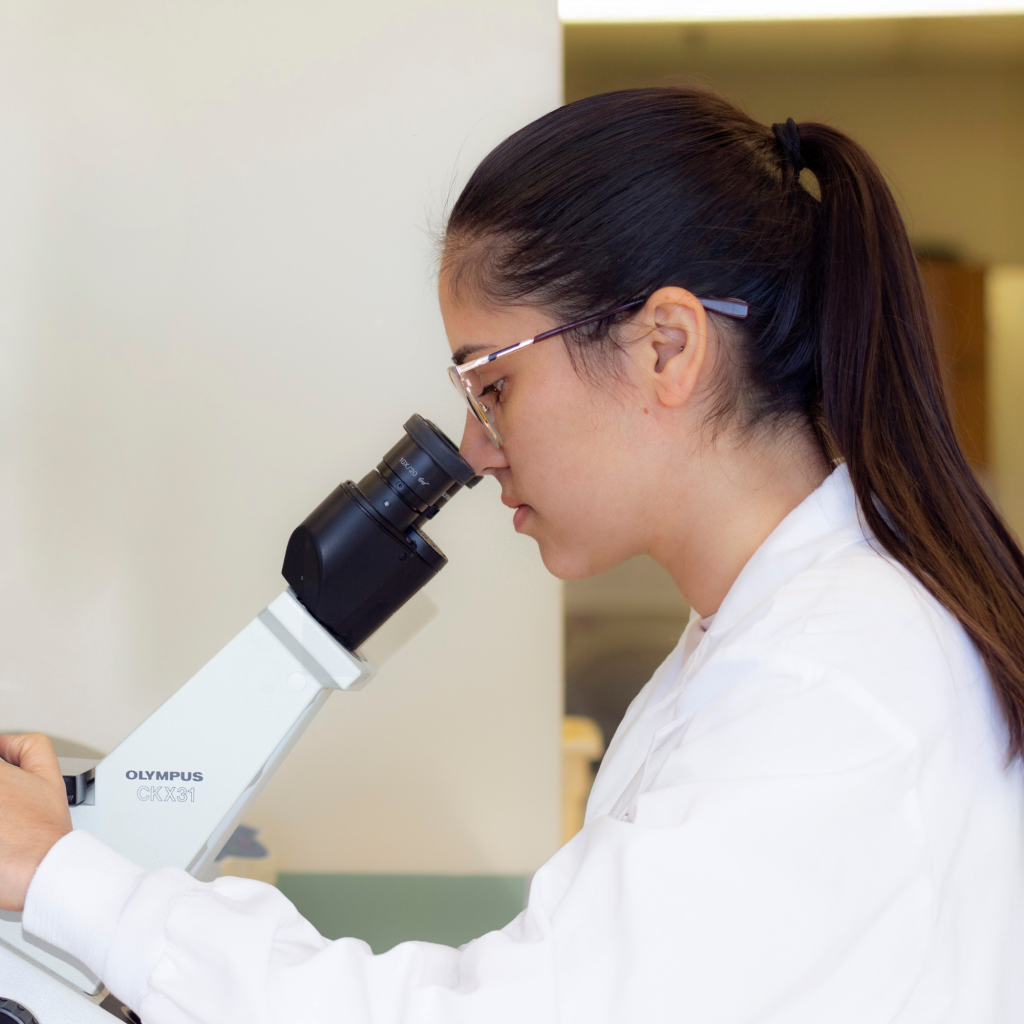
Anayra Goncalves is a PhD student in the Department of Anatomy & Cell Biology at Western
University. She is conducting BCC-funded breast cancer research under the mentorship of Dr.
Armen Parsyan and Dr. Alison Allan.
What specific areas of breast cancer research are you currently focusing on, and why are they
important?
My research focuses on triple negative breast cancer, one of the most aggressive and hardest-
to-treat forms of the disease. People diagnosed with this type of breast cancer often have
fewer treatment options, and chemotherapy is still the main treatment. I study tumour samples
from patients to better understand how cancer cells interact with the body’s immune system,
which normally helps fight disease. I use an innovative technology called spatial transcriptomics
to look at where different cells and proteins are located within a tumour, and this allows us to
learn why some cancers respond well to treatment while others do not. By understanding this,
we hope to help guide more personalized and effective treatments for breast cancer patients in
the future.
How do you see the future of breast cancer prevention, screening, diagnosis, treatment
evolving through research?
The future of breast cancer care is becoming more personalized. Advances in technology are
helping researchers detect cancer earlier, predict how tumors will behave, and match patients
with treatments that are more likely to be effective for them. Continued research will
ultimately help to make breast cancer care more precise and more effective.
Can you discuss any challenges or obstacles you’ve encountered in your breast cancer
research, and how you’ve overcome them?
Breast cancer is incredibly complex, especially aggressive subtypes like triple negative disease,
where tumours can behave very differently from one patient to another. Analyzing high-
dimensional data and patient samples requires both technical expertise and collaboration
across disciplines. In this journey, I have learned the importance of teamwork, good
mentorship, and remaining motivated through adversity. Every challenge is an opportunity to
refine our approach and move the research forward.
In your opinion, what role can public awareness and advocacy play in advancing breast cancer
research and treatment?
Public awareness and advocacy play a vital role in advancing breast cancer research because
they promote early detection and help sustain support for scientific progress. Early in my
academic journey, I participated in community outreach initiatives that highlighted how
education can empower people to recognize warning signs to seek care sooner, actions that can
truly save lives. That experience shaped my perspective as a researcher and reinforced the
importance of connecting science with the communities it aims to serve. When people are
informed and engaged, we move closer to better outcomes for everyone.
What message would you like to share with someone who has just been diagnosed with
breast cancer?
You are not alone. There is a global community of researchers, clinicians, and advocates
working every day to improve treatments and outcomes. Advances in research are happening
constantly, offering more options and more hope every day. Hold onto that hope. Many people
are committed to supporting you throughout your journey.