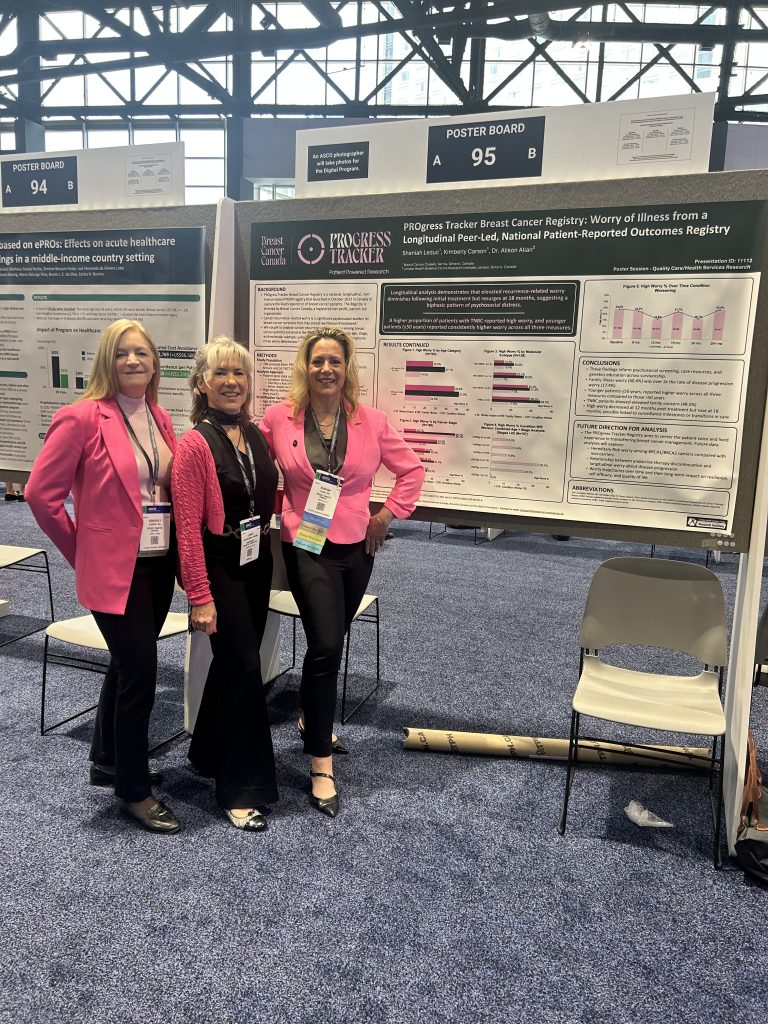

Understanding the “Burden of Worry”: New insights from PROgress Tracker Breast Cancer Registry
When someone finishes active breast cancer treatment, it’s often seen as the end of the medical journey. But for many survivors, that’s not how it feels.
Even after surgery, chemotherapy, or radiation are over, many people continue to live with worry: about the cancer coming back, about their family’s risk, and about what their future looks like. These concerns are real, ongoing, and often not measured in routine care.
Through Breast Cancer Canada’s PROgress Tracker Breast Cancer Registry, the first national, patient-led registry of its kind in Canada, we are working to better understand these experiences over time. The registry follows participants for up to 10 years and uses validated quality-of-life tools to capture what life is really like after treatment. Early insights from 823 participants are now helping us see clearer patterns in survivorship worry.
One of the strongest findings is that many survivors are not only focused on their own health, but on their families. The most common concern reported was hereditary risk, with many participants worrying about whether they may have passed a genetic risk on to their children or relatives. Another major concern was the impact of daily stress on health, followed by fear of the cancer returning or the condition worsening.
Thanks to Canadians sharing their experiences, we are tracking the “burden of worry” and uncovering important insights about survivorship:
🩷 The greatest concern reported is hereditary risk to family members (40.4%)
🩷 Many worry that everyday stress could impact their health (31.7%)
🩷 Canadians diagnosed before age 50 experience significantly higher levels of worry
🩷 Those living with Triple-Negative Breast Cancer (TNBC) and Stage IV disease report the highest levels of ongoing illness-related concern
🩷 Worry doesn’t disappear after treatment. While anxiety often decreases around 12 months, it rises again at 18 months, highlighting the need for continued support throughout survivorship
The data also shows that experience is not the same for everyone. Younger survivors reported higher levels of worry overall compared to those diagnosed later in life. This may be linked to the life pressures they are managing at the same time, including work, relationships, and family planning.
We also saw important differences by stage and subtype. People living with metastatic breast cancer reported much higher levels of concern about both family risk and their own health compared to those diagnosed at an earlier stage. Survivors with triple-negative breast cancer also reported higher anxiety levels than those with other subtypes.
Another important finding is that worry does not follow a straight line. While anxiety levels dropped for many people in the first year after treatment, there was a noticeable rise again around 18 months. This suggests that as regular medical follow-ups become less frequent, emotional support may also drop off—just when some people need it again.
As Shaniah Leduc from Breast Cancer Canada notes, these findings point to an important gap in care. Survivorship is not the same for everyone, and support needs to reflect that reality. Mental health screening, education, and tailored resources should continue well beyond active treatment.
PROgress Tracker is helping to fill a major gap in Canadian cancer care by following real patient experiences over time. This kind of data can help improve how we support people not just during treatment, but for years after.
If you have been diagnosed with breast cancer, your experience can help shape future care and research. The registry is digital, confidential, and self-referred. Learn more and register for the study, please visit: PROgressTracker.ca
We are grateful to everyone who has already shared their experience and continues to contribute to this work.
References:
Leduc, S. (Presenter). PROgress Tracker Breast Cancer Registry: Reporting worry of illness from a longitudinal peer-led, national patient-reported outcomes (PRO) registry. Poster presentation at the 2026 ASCO Annual Meeting, Quality Care/Health Services Research Session. Journal of Clinical Oncology, 44 (2026, suppl 16; abstr 11112).
Abstract available at: https://www.asco.org/abstracts-presentations/259818/abstract
Acknowledgements
Breast Cancer Canada gratefully acknowledges the patients participating in the Registry with a 10-year commitment providing long-term patient powered research on their lived experience. We also gratefully acknowledge research funding provided by individual donors to Breast Cancer Canada, as well as research grants from AstraZeneca Canada, Gilead Sciences Canada, Novartis Canada, and The Hecht Foundation.