
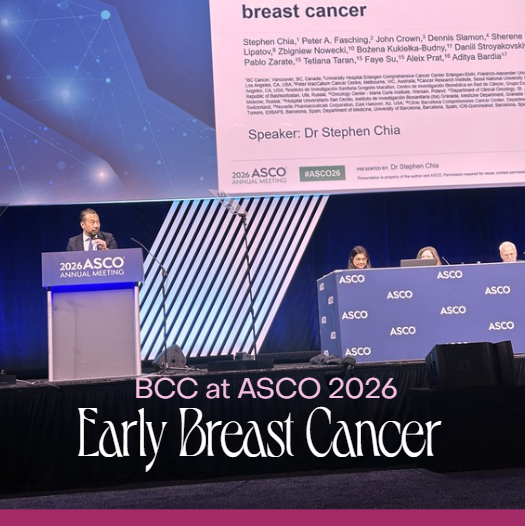
One of the most discussed themes at the 2026 American Society of Clinical Oncology (ASCO) Annual Meeting was the continued shift toward personalized treatment for early breast cancer. Researchers presented new evidence demonstrating how genomic testing can help identify patients who may safely avoid chemotherapy, ensuring treatment decisions are guided by tumour biology rather than traditional clinical factors alone.
OPTIMA Trial: Genomics Informing Treatment Decisions
Results from the international OPTIMA trial highlighted the growing role of genomic risk of recurrence profiling in treatment planning for patients with hormone receptor-positive (HR+), HER2-negative early breast cancer. Rather than treating all stage 2 patients with chemotherapy, the study evaluated the use of the Prosigna genomic test to determine which patients would benefit from chemotherapy and those that don’t. Investigators reported that patients identified as low genomic risk achieved excellent outcomes without chemotherapy.
There is a broader movement in breast cancer treatment: avoiding unnecessary therapies while maintaining excellent outcomes. For many patients, this means reducing exposure to the long-term side effects associated with chemotherapy, including fatigue, neuropathy, fertility concerns, and cognitive changes.
Building on the Foundation of Oncotype DX
The OPTIMA data further strengthens the body of evidence supporting genomic assays such as Oncotype DX in helping clinicians make more informed treatment decisions.
These tools provide insight into the biological behaviour of a tumour and its risk of recurrence, allowing treatment plans to be tailored to individual patients rather than relying solely on tumour size or lymph node involvement.
NATALEE and the Evolution of Risk-Adapted Care
The importance of personalized treatment was also reflected in discussions surrounding the NATALEE trial, which evaluated ribociclib (Kisqali) in combination with endocrine therapy for patients with HR+, HER2-negative early breast cancer at risk of recurrence. The trial continues to shape global treatment standards by identifying patients who may benefit from additional targeted therapy while helping others avoid unnecessary treatment escalation.
Canadian breast cancer expert Dr. Stephen Chia has been among the leading experts contributing to research and discussions surrounding treatment optimization in HR-positive early breast cancer, including the integration of CDK4/6 inhibitors such as ribociclib into clinical practice.
What This Means for Patients
Together, the OPTIMA and NATALEE studies reflect a growing commitment to precision oncology. Rather than taking a one-size-fits-all approach, clinicians are increasingly using genomic information and individual risk factors to determine who requires more treatment and who can safely receive less.
The goal is simple: deliver the right treatment to the right patient at the right time while also minimizing unnecessary side effects and preserving quality of life.
References + Further Reading
- OPTIMA Trial: Genomic Testing to Reduce Overtreatment
Reuters coverage of ASCO 2026 findings showing how genomic testing can help identify patients who may safely avoid chemotherapy.
https://www.reuters.com/business/healthcare-pharmaceuticals/veracyte-genomic-test-identifies-breast-cancer-patients-who-can-skip-chemo-2026-05-27/ - Groundbreaking Genomic Test Could Spare Patients Chemotherapy
The Guardian’s coverage of the OPTIMA trial and the growing role of precision medicine in early breast cancer.
https://www.theguardian.com/society/2026/may/29/groundbreaking-genomic-test-spare-breast-cancer-patients-chemotherapy-hormone-therapy - OPTIMA Trial Results Presented at ASCO 2026
Overview of the study supporting the use of Prosigna-guided treatment decisions in early breast cancer.
https://www.businesswire.com/news/home/20260521430337/en/OPTIMA-Trial-Results-to-Be-Presented-at-ASCO-Provide-New-Evidence-Supporting-Prosigna-Guided-Chemotherapy-Decisions-in-Breast-Cancer - NATALEE Trial: Ribociclib (Kisqali) in Early Breast Cancer
Journal of Clinical Oncology abstract highlighting long-term outcomes from the NATALEE trial.
https://ascopubs.org/doi/10.1200/JCO.2024.42.16_suppl.512 - Novartis ASCO 2026 Breast Cancer Data
Company summary of breast cancer research presented at ASCO, including Kisqali and NATALEE updates.
https://www.novartis.com/us-en/news/media-releases/novartis-advances-rlt-innovation-and-reinforces-leadership-prostate-cancer-breast-cancer-and-hematology-new-data-asco-and-eha - Oncotype DX Breast Recurrence Score
Information on genomic testing used to help guide treatment decisions for patients with early-stage HR-positive, HER2-negative breast cancer.
https://www.oncotypeiq.com/en-ca/breast-cancer - About Kisqali (Ribociclib)
Patient and healthcare professional information about Kisqali in early breast cancer.
https://www.kisqali.com